


Strategic Management of Construction Equipment Oils and Lubricants: A Look Back at the Jungent Latvia and Shell Industrial Conference
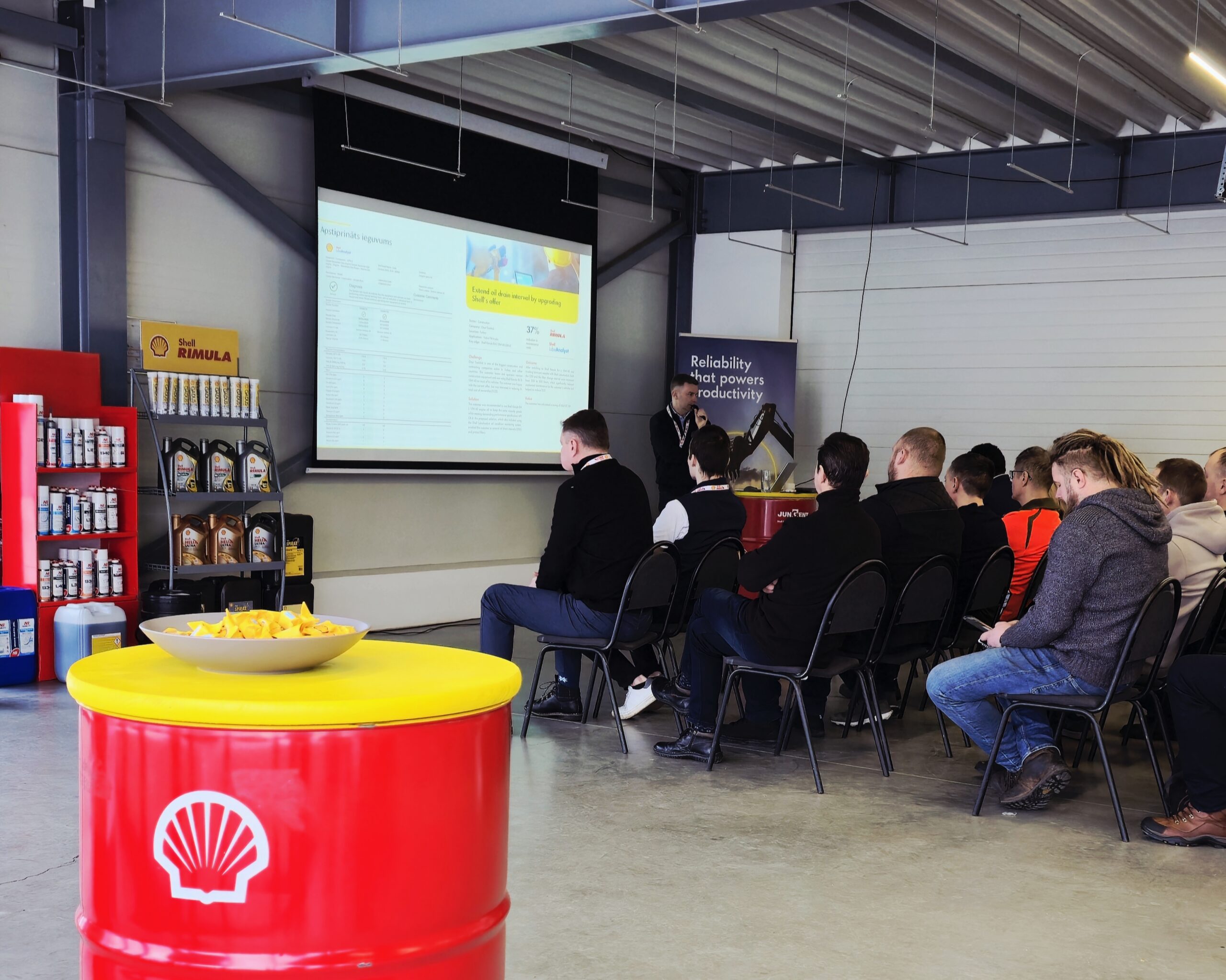
On February 11th, the “333” race track hosted a major industry event, bringing together construction company executives and fleet managers. The conference was organized by Jungent Latvia—the official Shell distributor in the Baltic States with 19 years of experience—in collaboration with Shell, which has been recognized as the world’s leading lubricants supplier for 19 consecutive years.
The event’s primary focus was to provide expert, in-depth knowledge on construction equipment lubrication solutions. The core goal: helping businesses reduce their Total Cost of Ownership (TCO), prevent unplanned downtime, and maximize the service life of their heavy machinery.
Innovations in the Engine Oil Segment: Shell GTL Technology
Kicking off the conference, Raimonds Sauja (Shell Lubricants Sales Manager in Latvia) guided attendees through the latest, strictest emission standards and how Shell Rimula heavy-duty engine oils have evolved to meet them.
A major highlight of the presentation was Shell’s Gas-to-Liquids (GTL) technology. This innovative process creates crystal-clear base oil from natural gas rather than crude oil, eliminating typical impurities. For construction equipment, this delivers several practical advantages:
- Reduced oil consumption and evaporation, thanks to stronger molecular bonds.
- Improved anti-friction properties, which directly contribute to fuel economy.
- Easier cold starts and reduced engine wear, ensured by a naturally higher viscosity index, even at extreme temperatures.
Evolution of Transmission Fluids: The Need for Specialized Products
In his presentation, Arnis Ģeris explored the technical nuances of the Shell Spirax transmission fluid range, highlighting the growing demands of original equipment manufacturers (OEMs). He stressed that historically popular STOU (Super Tractor Oil Universal) oils are no longer sufficient for modern construction equipment, as they fail to meet the stringent engine oil quality standards required by today’s machinery.
Relying on inadequate universal fluids carries significant risks:
- Foaming can occur in hydraulic systems, causing the system to “jerk” and leading to pump defects caused by cavitation.
- An inappropriate friction coefficient can cause “wet brake” noise and impair clutch performance.
To avoid these issues, modern machinery requires specialized UTTO or TO-4 specification oils (such as Shell Spirax S4 CX and S4 TXM). These fluids are precisely formulated to handle specific friction materials and heavy loads.
Hydraulic System Efficiency and Reliability
Andrés Nazir Orozco Ramírez, Technical Manager from the Shell Global Team, analyzed the challenges facing modern hydraulic systems—namely, increasing power density, higher operating pressures, and smaller oil reservoirs. These factors put immense stress on hydraulic fluids, which is exactly what Shell Tellus hydraulic oils are designed to handle.
The presentation showcased impressive test results for Shell Tellus S2 VX and the innovative Shell Tellus S4 VE. Unlike many alternatives, Shell Tellus products demonstrate an exceptional ability to separate from water and maintain high filterability even in wet conditions, preventing costly filter blockages. Additionally, the biodegradable Shell PANOLIN series was highlighted as the ultimate solution for ecologically sensitive environments, delivering maximum performance and protection while complying with strict environmental standards.
To demonstrate the financial impact, a Total Cost of Ownership (TCO) case study was presented: by switching a crusher’s standard hydraulic oil to Shell Tellus S2 VX 46 and utilizing Shell LubeAnalyst monitoring, a company successfully extended its oil drain interval from 800 to 2,000 hours, dramatically cutting downtime and maintenance costs.
Grease Specifications and Compatibility Risks
The theoretical section on lubrication wrapped up with practical guidance on selecting the right Shell Gadus greases. A crucial topic was the chemical compatibility of different thickeners. Experts warned that mixing incompatible greases (for example, combining a lithium-based grease with a bentonite-based one) can cause the mixture to become too liquid, harden, or bleed oil. This strips bearings and pins of essential lubrication, resulting in costly, irreversible equipment damage.
Professional NB Quality Solutions for Equipment Maintenance
The practical side of the event was complemented by Urmo Aava, who presented the product range of NB Quality, the leading technical aerosol brand in the Baltics. The brand offers field-tested solutions specifically tailored for harsh industrial environments, making daily mechanical work much easier:
- High-performance cleaners: ranging from universal solvents to powerful agents for removing deep soot and stubborn deposits.
- Fast-acting rust removers: featuring products with a cold-shock effect and special additives (MoS2, graphite) to tackle even the most complex dismantling jobs.
- Durable assembly greases and oils: ceramic and copper greases with moisture-resistant base oils, guaranteeing high adhesion, excellent corrosion protection, and thermal resistance up to +1200°C.
These advanced maintenance products are designed to speed up service routines and ensure reliable equipment operation, even in the most hard-to-reach components.
Practical Experience, Industry Machinery, and Car Tests
The informative sessions were backed up by a real-world defect analysis, allowing attendees to physically inspect engine, transmission, and hydraulic system components that had been damaged by the use of incorrect oils.
Our cooperation partners Baltem and Alwark added tremendous value to the event, giving attendees the chance to get up close and evaluate the latest, most powerful Komatsu and Hitachi industrial machinery right at the venue.
The conference concluded on a high note, offering participants an exclusive networking opportunity in an informal atmosphere, along with a chance to test their driving skills on the challenging “333” off-road track. An impressive fleet of vehicles was available for test drives, including the FOTON TUNLAND V9 and G7, Chery, VW Amarok, VW Touareg, and the innovative electric KGM pick-up, proving their mettle in real off-road conditions.
Summary
The significance and added value of the event for the industry were summarized by Ronalds Dzelme, Shell Marketing Manager in the Baltic States:
“This conference clearly demonstrated that choosing the right lubricants isn’t just a technical maintenance topic — it’s a strategic business decision that directly affects a company’s profitability. We are thrilled by the strong interest from industry professionals and grateful for the opportunity to share Shell’s global expertise right here in Latvia, blending valuable knowledge with an exciting experience on the track.”
Proper lubrication is an investment. Jungent Latvia and Shell would like to thank all participants and partners for contributing to a highly successful and professional event!